Why you sound like you're reading on camera – and how to stop
Short answer: You sound like you're reading because you read word by word instead of thought by thought. The voice flattens, pauses land in the wrong place and emphasis disappears. The fix isn't more rehearsal – it's a script written for speaking that shows you what matters before you reach the word.
Where does the reading voice really come from?
In free speech the thought comes first and the words follow. When reading, the order flips: the words come first and the thought only forms at the end of the sentence. Listeners notice immediately – the voice is flat and the pauses land on line breaks rather than on changes of thought.
That's why someone who is lively on the phone can sound stiff in front of a camera. It isn't about talent.
How can you tell the text is the cause?
- You stumble at the same places take after take.
- Long sentences run out of breath halfway.
- You stress words that carry no meaning ("and", "that").
- You sound better when you explain it in your own words without the text.
If two or more are true, fix the text before you rehearse more.
What helps fastest?
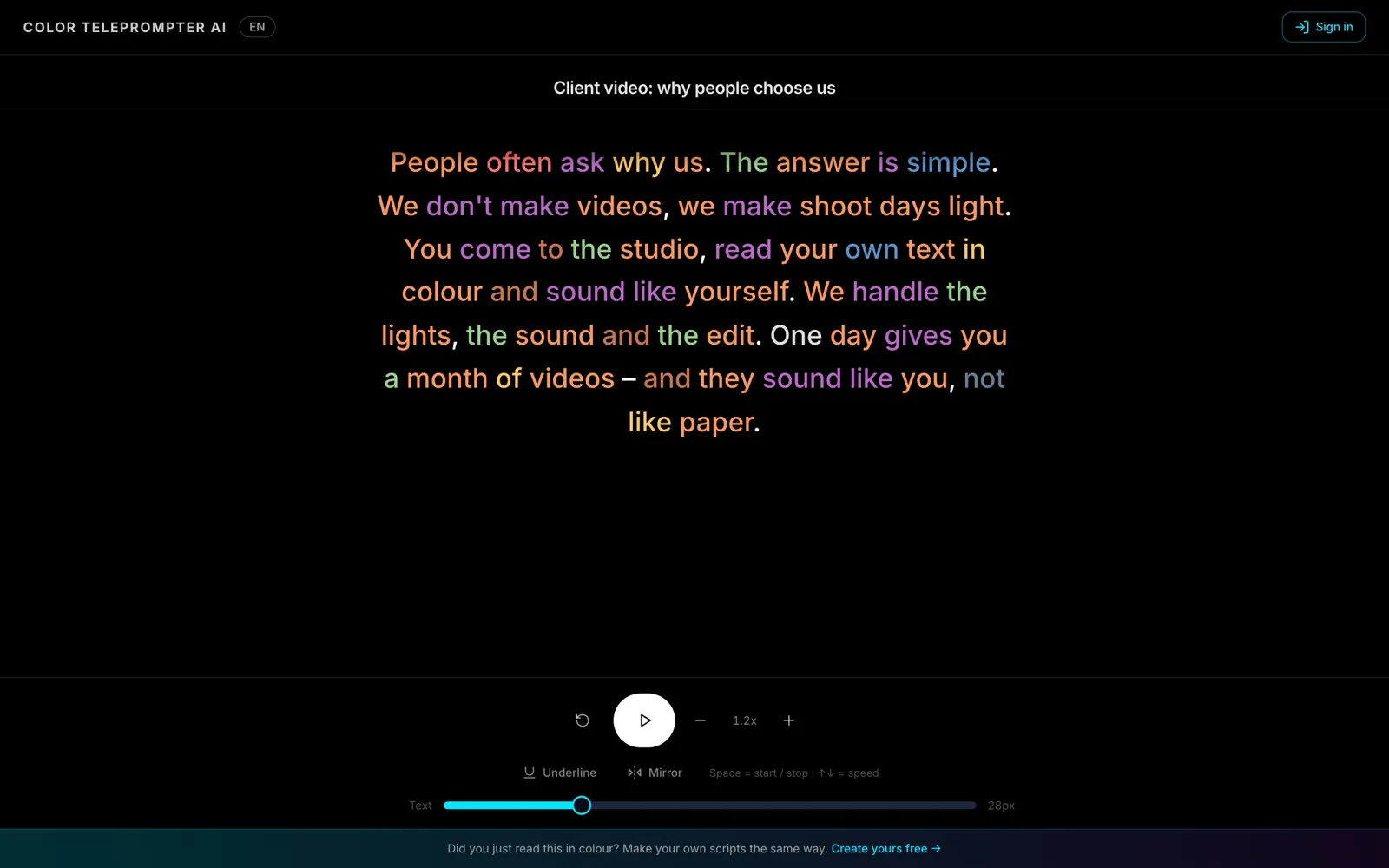
Three things: shorter sentences, marked pauses and seeing the emphasis before the word. The last is what an ordinary prompter doesn't do. When the verb and the noun stand out in colour, your eye finds the words that carry the sentence before your mouth gets there – and the emphasis comes almost by itself.
What if I'm colour-blind?
Underline mode shows the same structure as lines instead of colours. It also works if you find the colours distracting.
Try it with your own text in the live demo – or read more for creators.
Frequently asked
Is the reading voice caused by nerves?
Sometimes, but most often the cause is the text: sentences that are too long and emphasis that isn't visible before the word.
Does memorising help?
Memorised text often sounds memorised. A script written for speaking that shows the emphasis works better.